
Case Sites
The case sites will be parts of abandoned mines is following regions/coal basins of Poland, Belgium, Czech Republic, France and Germany.
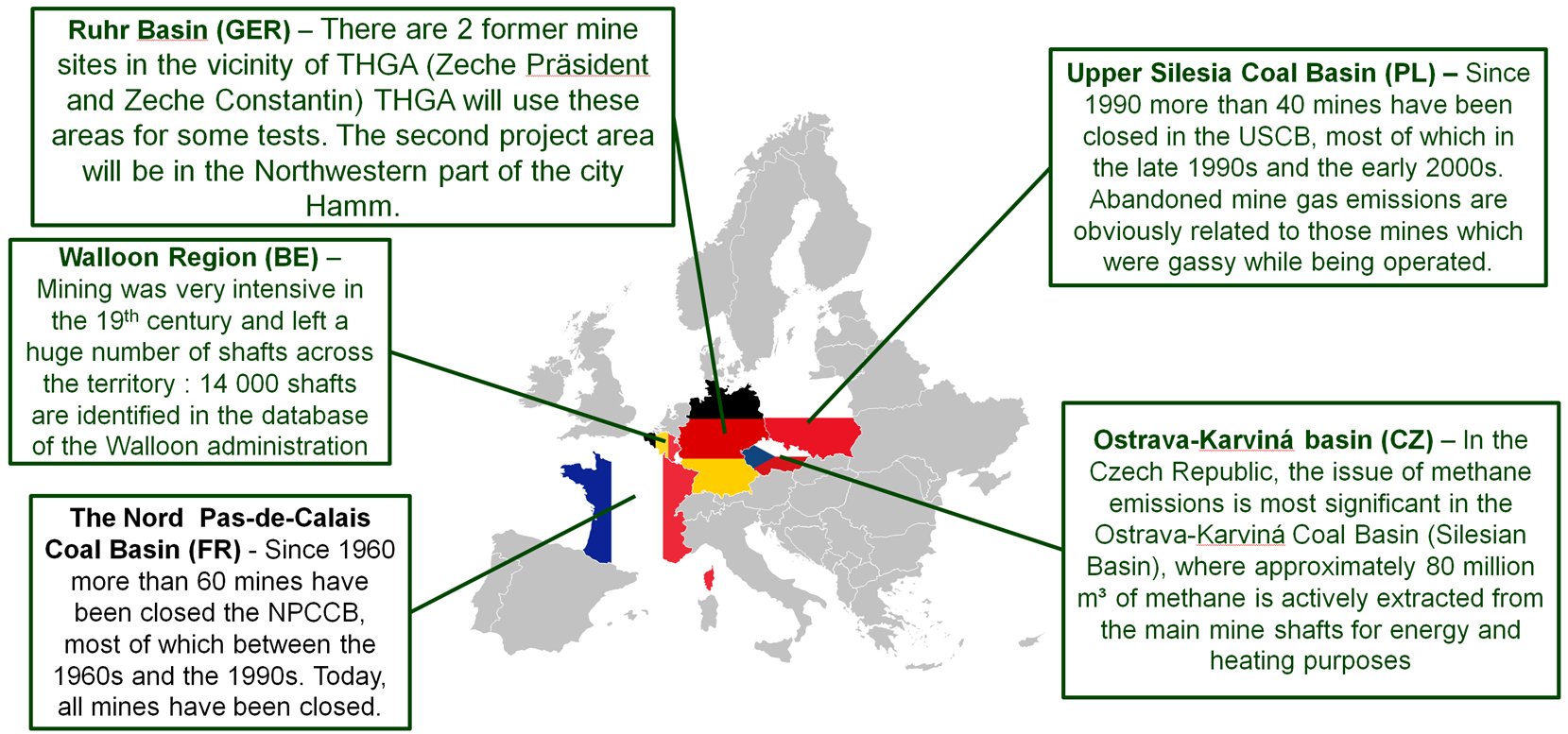
Figure 1 – Case Sites
Upper Silesia Coal Basin (PL) – Since 1990 more than 40 mines have been closed in the USCB, most of which in the late 1990s and the early 2000s. Abandoned mine gas emissions are obviously related to those mines which were gassy while being operated. Since gas content of coal seams in the USCB largely depends on coal seams depth, early mine closures were associated with shallow coal seams which were non-gassy or slightly gassy. Therefore, the gassiest mines were closed fairly recently. Overall, approximately half of all abandoned mines were gassy whereas several were very gassy with an operating methane drainage system in place. Total gas emission at the end of mining for the gassiest mines ranges from 9 to 75 million m3 per year. An important feature of the Upper Silesian mining conditions is the fact that the vast majority of mines are adjacent to one another. Therefore, when a coal mine is closed, the gas emission of this mine is taken over by the ventilation and drainage system of an adjacent mine or mines. This way, the methane hazard of the closed mine is substantially reduced although it does not entirely solve the problem of fugitive emissions. This is also the reason why there have been very few attempts to produce AMM gas using surface-to-gob wells in the USCB. The accessible emitting components (shaft, wells) will be analysed during project realisation to select measurement locations
Walloon Region (BE) – The Walloon Coal Basin forms an almost continuous band of 175 km length from West to East of the region, with a maximal width of 15km (N-S). The basin is characterized by thin coal layers (0.5 to 1m) that were mined out at depths between 900 and 1500 m. All collieries are now abandoned, the last one being closed in 1984 in Charleroi area (Roton-Farciennes). Mining was very intensive in the 19th century and left a huge amount of shafts across the territory : 14 000 shafts are identified in the database of the Walloon administration but probably much more shafts are not identified because early traces of coal mining date back to the Middle Ages. The occurrence of methane was a serious issue during the mining activity, sometimes leading to mine closure or the development of gas drainage networks (West of Mons, Centre and Charleroi Basin). The most gassy shafts were located in the south of the basin. The first experience of mine methane drainage was in 1943 (Mariemont-Bascoup colliery). During the 1950’s, mine gas drainage became common practice in gassy mines with volumes of several millions Nm³ produced monthly. To overcome fluctuation in production and composition, networks developed across collieries, particularly in Charleroi area (Monceau-Fontaine). After the closure of the mine, some sites were set for gas drainage until 1990, with commercial applications. About 450 Mm³ of methane were gathered and valorised. Methane occurrence sometimes also sounds as an opportunity for new projects like AMM (Péronnes-Anderlues in the Centre Basin is currently producing) or CBM (feasibility studies in the Hainaut province). Monitoring campaigns of methane emissions were recently carried out across Wallonia, targeting the surface area of old mine shafts that could act as permeable ways for gas migration from old mine works. Those campaigns show that gas emission is limited in the monitored sites, concentration ranging from 0 to a few dozen of ppm. This low emission should be related to the fact that most of the shafts monitored are properly sealed and secured, and water rebound, while not monitored, could have reached its maximum level in these areas. However, strong methane emissions were still detected at some shafts, in the Hainaut province namely, where coal seems were known to be gassy. This shows that gas content can still be significant in some old sites, and that leakage can be expected in regard to the shafts sealing state.
The Nord Pas-de-Calais Coal Basin (FR) - Since 1960 more than 60 mines have been closed the NPCCB, most of which between the 1960s and the 1990s. Today, all mines have been closed. Abandoned mine gas emissions are obviously related to those mines which were gassy while being operated. The NPCCB is historically reputed for its high gas content of coal seams with an important number of accidents linked to the gas as well as specific methane emissions measured up to 190 m3/ tonnes of coal mined. An important feature of the coal basin is the fact that it is subdivided into several sub-reservoirs, which can be connected by faults. Therefore, when a coal mine is closed, the gas can still be transported into another part of the reservoir. Such phenomenon complicates the monitoring of fugitive emissions which occur from ancient shaft. Current monitoring still highlights high contents of methane, explaining its current exploitation to produce AMM gas in the basin.
Germany – There are 2 former mine sites in the vicinity of THGA (Zeche Präsident and Zeche Constantin) THGA will use these areas for some tests. The second project area will be in the Northwestern part of the city Hamm because methane is here degassing from abandoned underground coal mines. Finally, the project area will be the former coal mine site Ibbenburen. In that city coal mining ceased in 2018 and since 2020 THGA is monitoring the methane degassing process from the mining area.
Ostrava-Karviná basin (CZ) – In the Czech Republic, the issue of methane emissions is most significant in the Ostrava-Karviná Coal Basin (Silesian Basin), where approximately 80 million m³ of methane is actively extracted from the main mine shafts for energy and heating purposes (managed by DIAMO and GreenGas). Moreower, the DIAMO statestate has historically implemented hundreds of degassing boreholes, drainage systems, and other protective measures to ensure public safety. These elements serve to prevent uncontrolled releases of mine gases (methane) to the surface and minimize the risk of industrial accidents, such as methane explosions. Beyond this targeted utilization, the region has seen the implementation of extensive methane mitigation and monitoring systems as part of a project carried out between 2010 and 2019, which included:
- 284 degassing and monitoring boreholes,
- 15 drainage degassing systems designed for building protection,
- 3 active degassing systems for controlled methane extraction from underground,
- 127 electronic monitoring systems equipped with 528 methane concentration sensors.
These systems cover an area of 19 km² across the districts of Frýdek-Místek, Karviná, Opava, and Ostrava. However, the intensity and total volume of methane emissions from these systems remain unquantified, representing a significant gap in current emissions monitoring and management.

Funded by the European Union. Views and opinions expressed are however those of the author(s) only and do not necessarily reflect those of the European Union or the European Education and Culture Executive Agency (EACEA). Neither the European Union nor EACEA can be held responsible for them.
© 2026 memo.gig.eu | Accessibility Statement