
Consortium
9 Partners from 5 Countries.
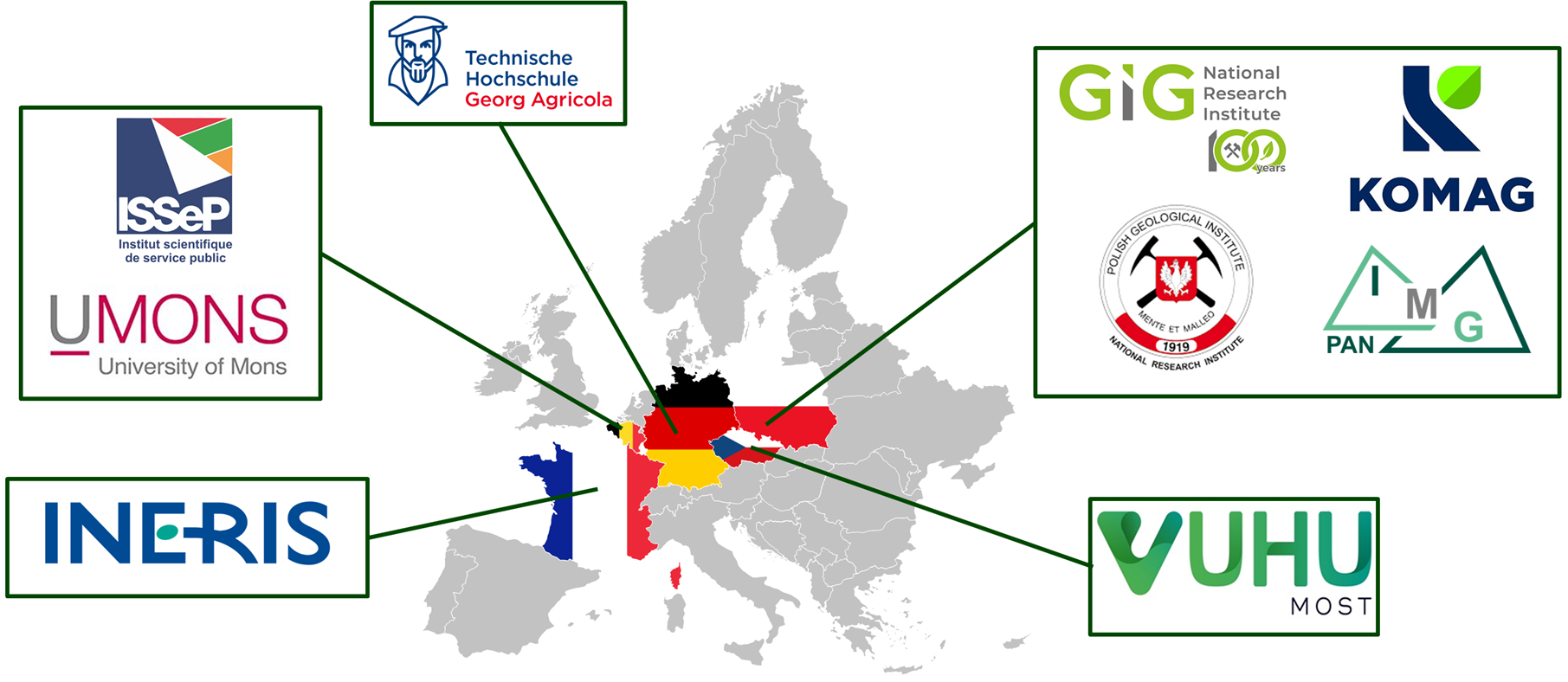
Consortium Partners

GIG is the acronym of Główny Instytut Górnictwa – Państwowy Instytut Badawczy) is a scientific and development organization, subordinated to the Ministry of State Assets, working not only for the benefit of the mining industry, but also for enterprisesrepresenting different branches - including small and medium enterprises, state and local administration institutions and offices, and foreign partners. Currently four basic areas of GIG’s activities with its almost 500 specialists and experts cover: mining engineering, environmental engineering, problems relating to quality, education and training. The key personnel to be involved into the REM project represents Central Mining Institute’s Team of senior scientists and engineers, who are experts in different mining disciplines e.g.: in methane drainage (GASDRAIN - RFCS project), strata control (MAPROC - RFCS project), underground hard coal exploitation. Representatives of above departments participate in the activities of safety and post-mining accidents’ commissions constituted by the President of the State Mining Authority as well as in International Conferences on Safety in Mines Research Institutes, scientific-technical conferences devoted to the development of innovative mining methods, international strata mechanics workshops and follow worldwide development and implementation. Considering more than 90 years of experience in mining related domains Central Mining Institute and Experimental Mine “Barbara” has extended knowledge of Upper Silesian Coal Basin and other foreign coal basins and is fully capable to participate in this project. List of international projects GIG was recently involved: METHENERGY PLUS (2017-2020), Methane recovery and harnessing for energy and chemical uses at coal mine sites, PICTO (2018 - 2021): Production Face Environmental Risk Minimisation in Coal and Lignite Mines. HYDROCOAL Plus (2018 - 2021): Development of Hydro Borehole Technology for Environmental Friendly and Cost Effective Brown Coal Deposits Exploitation. GasDRAIN (2015 - 2018): Development of Improved Methane Drainage Technologies by Stimulating Coal Seams for Major Risks Prevention and Increased Coal Output. MAPROC (2015 - 2018): Monitoring, Assessment, Prevention and Mitigation of Rock Burst and Gas Outburst Hazards in Coal Mines. ExPRO (2015 - 2017): Prediction and mitigation of methane explosion effects for improved protection of mine infrastructure and critical equipment. MERIDA (2015 - 2019): Management of Environmental Risks During and After mine closure.

The National Institute of Industrial Environment and Risks (Ineris) is a French public research institute of about 600 staff members, dedicated to providing scientific and technical support to the Ministry for the Environment. Created in 1990 from the merger of Cerchar and Ircha, it builds on nearly 70 years of combined expertise. Its mission is to prevent risks posed by industrial and economic activities to human health, the environment, and the safety of people and property. Ineris conducts research aimed at understanding the processes that lead to hazardous situations and at strengthening prevention strategies. The institute develops strong capabilities in the areas of accidental, chronic, and ground related risks. Through its Territory and Site Division, it brings together multidisciplinary skills in geotechnical engineering, geology, rock and soil mechanics, and geophysics. Ineris provides expertise and services related to geohazards such as mining risks, quarries, landslides, rockfalls, underground structures, reservoirs, and dams. It also operates e.cenaris, a 24/7 monitoring center managing numerous multi parameter systems for tracking ground instabilities and structural risks. Its work is organized around four cross disciplinary themes: understanding geo structure evolution, instrumental observation and monitoring, multiphysical numerical modelling, and the study of soil–structure interactions. Ineris supports these activities with unique experimental platforms and open research collaborations.
IMG PAN - The Strata Mechanics Research Institute of the Polish Academy of Sciences conducts fundamental, applied, and implementation-oriented research, including design and development activities. The Institute’s research focuses on current scientific challenges, including, among others, the impact of mining operations on the environment. The Institute carries out research related to the implementation of the MEMO project, such as the development of methods for measuring methane volumetric flow rates in complex ventilation networks; investigations of the physical properties of rocks, including gas sorption and desorption phenomena; and methods for assessing methane emissions from the surfaces of open-pit lignite mines. Extensive and labor-intensive experimental studies are conducted to verify the developed theories and methods for analyzing physical phenomena and processes. The Institute continuously advances its measurement techniques and, using both proprietary and commercially available research equipment, performs experimental investigations in laboratory settings as well as at real-world sites. As part of its research activities, the Strata Mechanics Research Institute of the Polish Academy of Sciences also conducts advanced numerical simulations in the field of computational fluid dynamics (CFD).

ISSeP is a public interest organisation under the direct supervision of the Walloon Government. Its competencies are environmental metrology in Wallonia (water quality, air, soil, sediment, waste, etc.), risk assessment/management (environmental, natural, subsoil and technological), and technological development.
ISSeP mainly provides technical and scientific support to the Walloon public authorities. Thanks to these missions and to its research, the ISSeP has extensive experience in the organisation and interpretation of environmental data. ISSeP has experience in assessing risks arising from the underground environment, specifically geological and mining risks. Indeed, Wallonia has a long history of mining (mainly coal mines, but also metal mines). Although there are no longer any active mines in Wallonia, most having closed by the middle of the 20th century, the risks associated with their presence (gas risk, collapse,water outbreak) are still present and require monitoring. At the request of the Walloon public service, the ISSeP's Underground Risks Department (URD) is missioned for risk monitoring of the post-mining environment (shafts and galleries, drainage adits, mine heaps, etc.). Scientific research is also a core activity of the URD, who has namely set up the ‘METHAMINE’ project, which aims to better quantify methane emissions from former mining sites.

KOMAG is a state-owned research and development organisation, subordinated to and supervised by the Ministry of State Assets. It has 155 employees, 100 of whom are scientific and research and technical specialists. The scope of KOMAG activities includesscientific, R&D projects - at national and European level - in the fields of mining and mineral processing; control and monitoring systems; energy storage and transmission systems; electric and battery drive systems; environmental protection; occupational safety; air and surface protection. The results of the projects are also implemented in other fields. In the more than 70-year history of KOMAG, some 4,500 inventions have been filed for protection, including patent protection. All departments and infrastructure necessary for the Institute's operation are in-house (no outsourcing). It has its own financial, administrative and human resources departments; a quality and knowledge management department (including a technical library and a library of necessary standards); a project administration and finance department; a research-related administration and finance department and an IT department. All departments are equipped with the necessary hardware and software. KOMAG's expertise in mining dust and methane emissions is built on over a decade of research and practical application. The organization’s specialists have a deep understanding of the impact of dust on mining equipment, focusing on explosion risks and ensuring proper operation in hazardous conditions. They have significant experience in identifying shafts responsible for methane emissions, both in mines and landfills, and have conducted extensive studies on methane measurements in coal mine exhaust shafts. KOMAG possesses the competencies necessary to design, implement, and analyze mechanical and electronic systems, as well as to conduct advanced research. Their comprehensive knowledge and achievements, particularly in European projects, make them an ideal partner in project consortia.
The Technische Hochschule Georg Agricola University (THGA) is a non-profit educational and research institution founded in 1816 as a school of mining in Bochum, Germany. Together with the German Mining Museum it is part of the DMT-Gesellschaft für Lehre und Bildung mbH. Following Germany's decision in 2007 to phase out coal mining, the THGA strategically redirected its focus towards mine closure and post-mining challenges. In 2015, it established the Research Institute of Post-Mining to carry out research in four key areas: mine water management; geomonitoring in post-mining regions; material sciences for industrial heritage and land-use & transition strategies. The institute's team is made up of various scientific experts including hydrogeology, geochemistry, mining engineering, economic and social sciences. It is equipped with advanced technological infrastructure and a dedicated science lab, including drones fitted with multispectral and thermal cameras and gas isotope analysers designed specifically for detecting methane emissions from abandoned coal mines.
Within the MEMO project, THGA assumes a key role as the lead organisation for Work Package 5 (Scientific and Public Dissemination), contributing significant expertise in the development of methodologies for classifying emitting mining components, and leading the preparation of technical guidelines for methane monitoring that align with EU regulatory standards.
The University of Mons (UMONS) is a leading Belgian institution with 7 faculties, 2 schools, 10 research institutes, and nearly 8,000 students across two campuses. It is internationally recognized for research excellence, ranking 41st worldwide in U-Multirank for publications in international partnerships and appearing in the QS and Shanghai rankings, notably in science, chemistry, physics, and materials engineering. Within UMONS, the Mining Engineering Unit, headed by F. Descamps, belongs to the Faculty of Engineering, formerly the Mons School of Mines. Its teaching and research cover the entire mining value chain, from geology to mineral processing. The unit specializes in engineering geology and rock mechanics, focusing on structural geology, rock material behavior, stability analysis, and rock destructibility through laboratory and in situ studies, using experimental and numerical methods. Located in the historic Walloon coal basin, it has expertise on underground coal gasification, CO2 sequestration, methane recovery, and abandoned mine stability. It also develops advanced 3D geological and mine modeling. Combining geology, mining techniques, and archives, the unit has unique expertise in the basin’s geology and coal properties, making it a key player in sustainable mining and energy recovery research.
Polish Geological Institute (PIG) was founded on the 7th of May 1919 on the strength of the Resolution of the Parliament of the Republic of Poland. It is the oldest Polish nationwide scientific institution. It is involved in comprehensive studies of geological structure of the country for practical use in national economy and environmental protection. In addition to scientific activities in all fields of modern geology the Institute was entrusted with the tasks of the Polish Geological Survey and the Polish Hydrogeological Survey. Moreover, it is responsible for the country’s security in supply of mineral resources, the groundwater management, for monitoring of the geological environment and warning against natural hazards and risks. In February 2009, the Council of Ministers bestowed the Polish Geological Institute the status of National Research Institute in recognition of the achievements and contribution to the developments in science and national economy during last 100 years. Legal Status: Research and Development Unit, National Research Institute, Supervising Institution: Ministry of Environment The Polish Geological Institute belongs to the association of European geological surveys – EuroGeoSurvey (EGS) with its sear in Brussels. SCOPE OF PIG ACTIVITIES • Comprehensive studies of the geological structure of Poland • Geological, geoenvironmental and hydrogeological mapping • Evaluation of national minerals resources potential • Evaluation of quality and resources of groundwaters including mineral and thermal waters • Monitoring and analysis of wide spectrum of geological issues of the natural environment, including groundwaters • Acquisition, storage, processing and dissemination of geological and geoenvironmental information on the entire territory of Poland, including the marine sea • Expertise on a wide array of geological issues for the state administration and self governments • Cooperation with geological surveys and organizations involved in geological research in other countries • Editing and publishing maps, atlases, periodicals and series of publications in geology

The VUHU a.s. was established in Most in 1953 as a part of state owned mining companies in north-western Bohemia as one of the first organizations focused on solving and documenting the complex issues of the development of brown coal open-pit mining in former Czechoslovakia. After the revolution, it was transformed to joint stock company owned by the teo brown coal mining companies. In recent years, the company’s activities have focused on providing a comprehensive portfolio of environmental, science, engineering, laboratory and environmental services, including ecological methods of coal treatment and use, and the use of lignite combustion and desulphuration products. Our department for Geotechnics is a multi-disciplinary research centre interested in large-scale stability analysis of open-pit mine slopes, dumps and heaps. We offer wide portfolio of services: soil sampling, soil and rock mechanics tests, project management and geotechnical supervisions of mining activities and earth works, analysis based on limit equilibrium methods numerical, FEM and numerical modelling, in-situ geotechnical test and geotechnical monitoring, slope failure remedy design and back analyses based on monitoring results, feasibility study of the utilization of chosen secondary material in earthworks. Drone based surveying of open-pit mines is a fast, precise, yet cost-effective manner of mapping and documentation. At VUHU, we can survey the area with a powerful photogrammetric camera drone in GNSS RTK precision. We then adopt the subsequent data evaluation exactly to your requirements. We cover 3D surveying from serial image calculations in the following areas: large open-pit mines, quarries, sand and gravel pits, dumps & landfills, building and line constructions and their monitoring. All our laboratory expertise and tests have been accredited since 1994 and meet the strict requirements for methodology and quality of outputs. As part of the activities of the accredited testing laboratory no. 1078, we provide a wide range of tests focused on protecting the living and working environment, utilising state-of-the-art techniques and methods following to European and national standards. Laboratory is also equipped with different experimental devices, regarding pyrolysis and hydrogenation tests, palletisation of various materials and utilisation of energetic by-products, solid fuel sampling and analysing, collection and analysis of various waste materials with regard to their other uses,sampling and analysis of mining water, surface water and wastewater, determination of dust and its dependence on meteorological conditions, determination of noise pollution in outdoor and indoor environment.

Funded by the European Union. Views and opinions expressed are however those of the author(s) only and do not necessarily reflect those of the European Union or the European Education and Culture Executive Agency (EACEA). Neither the European Union nor EACEA can be held responsible for them.
© 2026 memo.gig.eu | Accessibility Statement